Showing posts with label Jack James. Show all posts

Sunday, 10 September 2017

Kermode Bear


Jack James was the manufacturer and retailer of Radiant Lures for decades. These were used in Saanich Inlet fishing, as well as other places, and more recently the company changed names to Super Tackle. Matt James, Jack’s son, retails the tackle on his site www.superflea.ca. I asked Jack about the spoons he once had that would glow for hours in the dark, as in a far longer time than other glow lures. 

He sent me home with a few packages of current plankton-sized and halibut-sized hootchies from Super Tackle. Once charged with a light, or even a small LED flashlight, they do indeed glow almost all night long. I put two packages on my bookshelf, and if I wake in the night, there they are glowing away. What this means is that the lures will indeed emit glow for as long as the lure is fishing at depth, not simply for five minutes, as older versions of glow used to do. You should pick some up for your winter fishing that is done at depth beyond the visible spectrum.

Here is an image of some of the Super Tackle hootchies, quite colourful:


Now, to deviate a bit from fishing, in this case Saanich Inlet, when I was sleuthing through the collectibles in Jack James house, there was a wonderful painting of a spirit bear and I took some images of it. It is quite large, perhaps 2 X 3 feet.

Here is what Jack had to say in a note to me when I asked about the painting:

“In 1942-43, during the war – I went to school, grade 7 and 8 at South Park School. Every day after school my best friend and I walked through Beacon Hill Park on the way to beach comb at our log fort in Torpedo Bay. On the way, we stopped at the Kermode Bear’s (Spirit Bear’s) cage and fed her an orange.

To get her to eat these oranges, in the beginning we rubbed our stomachs in a circular motion, to show the bear they were good to eat. After a number of times, this bear, when it saw us coming, would stand up at the cage bars and copy this motion. We had difficulty getting these war-rationed oranges from our parents.

I took pictures of this bear named Ursus Kermode, from Kermode Island, which was captured by a Mr. Kermode with a cub bear. The cub died in captivity in the late 1930s. I sent the picture I took with an old box camera and asked my son to do the new medium in art on his Gilcee (could be, Giclee, as I wasn’t sure of Jack’s hand writing) machine.

He put the picture in his machine and got some outdoor background work. He machine printed his new art medium work, and coloured it as you see. As the colouring paint is very expensive I paid him for it. This magnificent art work is done on Everlasting Canvas. It will last forever. 

I sell my son’s art works, and have sold dozens over the past few years! Matt sells art works on his website. I have a small framed one for sale for $100; however, the one you took the picture of is $5000. 

During our beach combing, the US navy and RCN practiced dropping depth charges off the Victoria waterfront. Many fish and other sea creatures floated up and we often took fish home to our surprised mothers. One day, I dragged a large octopus home – and got grounded for a few days!
Thanks for the reminder of this Spirit Bear. The Island it came from has been renamed..”

Here is the image of the beautiful processed painting:


Sunday, 16 April 2017

VSIAA Prize Winners and Ernie Fedoruk


More good stuff from the ample, overflowing treasure trove of Jack James’ ‘files’ (this is a word that means his entire basement and back yard garage of fishing related stuff, including a collection of old licence plates that is truly out of this world) on Saanich Inlet fishing in the ‘good ole’ days’.

Two things this week:

Prize Winners

This image is a bit smudgy as it came to me as a photocopy of an almost sepia-like piece of newsprint, presumably the Times Colonist, that endured for decades (‘60s, maybe?) and then was photocopied to give to me. I took a digital image and did a little ‘improving’, to find the text is more readable in the image than original. Zoom the image to find out who is who.

Here are a few: The person standing far left is Jim Gilbert, probably the most famous of our historical fishing confederacy. Think of politicians we now hold in esteem like John A. MacDonald or the other guy… ah yes, George Washington. They were nation builders, sure, but not as important as sport fishers.

Jack James is sitting on lower right with the trophy and box of buck-tails and hootchies. The fellow sitting on the left is Kjell Pedersen, who won the Jim Gilbert trophy for biggest fish on a drift fishing lure, in the Stamp River, at 44 pounds. You will note that Ken Turnbull won the grand hidden weight prize of a CP trip to Amsterdam with his wife Margaret, for, get this, a 7.5 pound coho. Where do we sign up to win? On the far right is Bruce Colegrave of Scot Plastics who was one of the top fishers when I cut my teeth in the Inlet in the mid-seventies.


Ernie Fedoruk

After Alec Merriman, Ernie wrote the fishing column for the TC, then Rob Waters, then me for a decade. The column below, probably from the 1970s, tells the story of how we got UV and ‘glow’ in the lures we fish with today. I have transcribed it verbatim, including the US spellings.

Stamp Collector Sheds Light on Lures

The fishing fraternity would be very callous if it did not send Joan James a dozen roses…or at least a card of thanks.

She brought light into the lives of anglers because, being a stamp collector, she introduced the awareness of ultra violet radiation to her lure-distributing husband.

As a result, the anglers and hubby’s business all have improved on success.

Jack James and partner Ted Packford own Radiant Lures, a Victoria cottage industry that now dominates sales of plastic bait – the ones commonly called hootchies and squires – to those who pursue West Coast salmon, steelhead and trout, not to mention halibut and other groundfish.

Benefits also have spilled off to others, including rivals in the tackle industry.

Radiant’s almost-bizarre named lures like Army Truck, Devil’s Tail, Zapper, Clover Leaf, Peanut Butter, Polar Mist, Mint Tulip and Fuddle Duddle may not mean a thing to the non-fishing population. But all are well known, understood and very popular with all who fish British Columbia’s waters.

The ‘glow’ baits have increased catching success.

Teamed with rolling flashers such as the Hot Spot or Oki on a 36-inch leader, hootchies are designed to imitate squid, while the squirts resemble needlefish (or sandlance) – both relished by salmon.

Lures that react to UV rays now dominate Radiant’s stock. Interestingly, the search for titles honors the Packford and James families as well as Jack’s former firefighting profession (Firebrand and Fire Chief).

He declined to identify the Red Dragon’s origin but Jack admitted he has yet to name a lure after his wife.

“It will have to be special,” he suggested, “because she is the one who twigged the industry onto the significance of UV rays.”

While others used colors that reacted to UV rays, James is convinced “no one in the industry related its (UV) impact to fish-catching success…as far as I know.”

Only within the past decade were sports anglers able to catch sockeye, thanks to small pink squirts. Before then, that salmon species almost totally ignored sport-fishing offerings.

The choicest of the salmon species was considered by most as a fish that could only be taken by nets.
Then commercial trollers and the sporties started to hook sockeye. The success of tiny pink lures spread.

About six years ago, Jack, working in his basement, wondered about why the pink color worked so well on sockeye.

“Maybe it reacts to ultra violet,” suggested his wife, and then she asked: “Do you want me to get my UV light?”

Like all stamp collectors, Joan considers a UV lamp important to her hobby. It helps verify the authenticity of most stamps. 

Stamps from most countries are edged with a color shade that reacts to UV rays. It began in the 1960s when post offices introduced cancelling machines. The UV edging ‘tells’ the machine when the stamp is in its proper place for cancellation.

Joan’s light proved the pink sockeye lure was, indeed, a color that reacted to UV. Jack made another discovery that day. He hauled out an old pearl pink Lucky Louie plug to see if that lure reacted. It did.

James says deer hair, a favorite with those who make flies, also reacts to UV radiation.

Ultra violet radiation, almost surely, is one reason why some lures are hot and some are not.

                                                       *******************
Here is an image of Radiant Hootchies, including most mentioned above. Zoom in to read the names:


Sunday, 19 March 2017

Victoria Saanich-Inlet Anglers Association


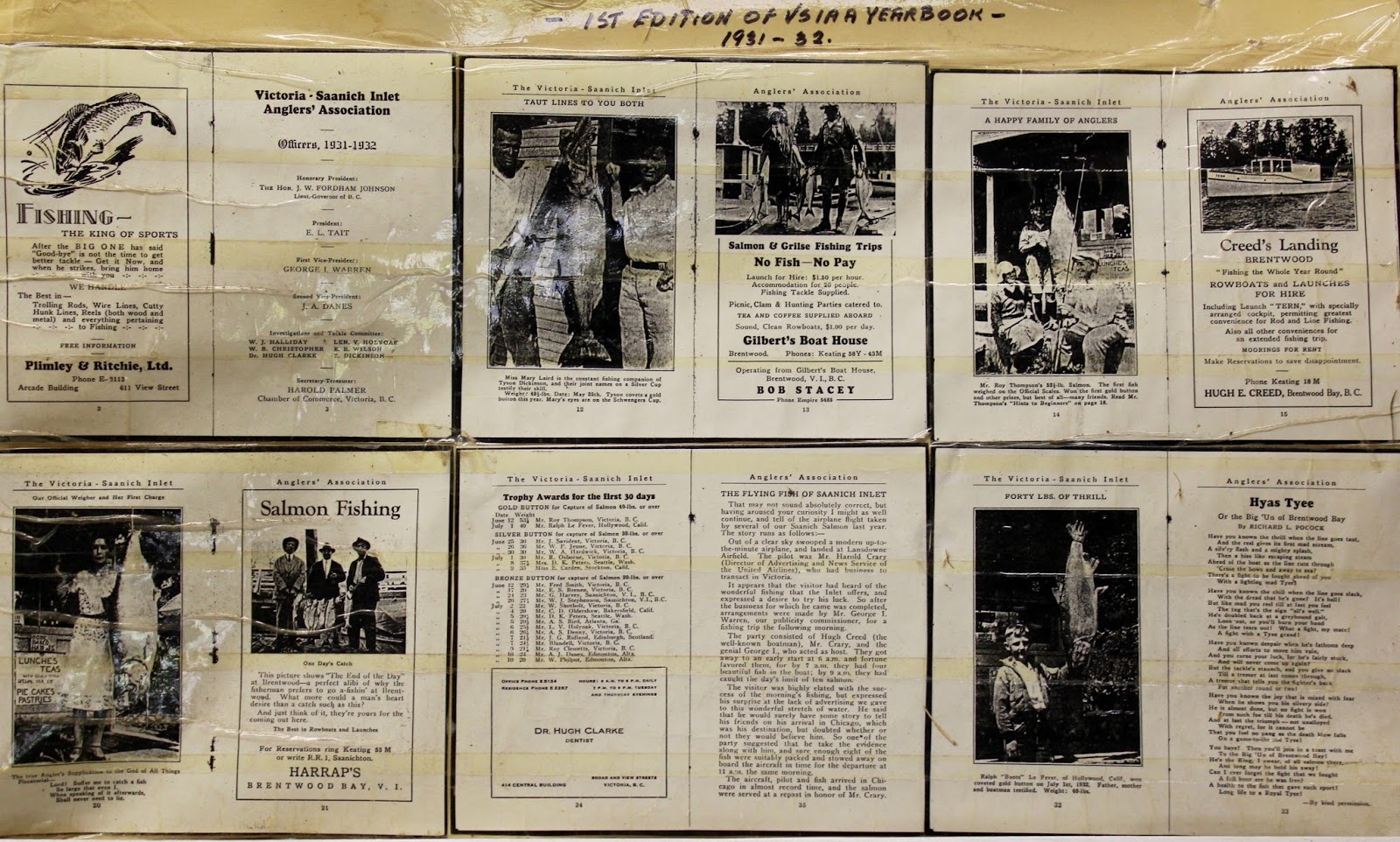
I went over to talk with Jack James, Mr. Radiant Lures himself, the other day, and left with a sack-full of images, lures, photocopies, and etc., detailing Saanich Inlet sport fishing over the decades. This included images of an original copy of the VSIAA’s club booklet, this one from 1931-1932. The booklet would have been a minimum of 36 pages, so a pretty impressive publication and record of Saanich Inlet.

These days I am viewing a zoomed digital image on my iMac 27 inch, high RAM computer with Bluetooth and WIFI, for making digital movies with Premiere Pro, the Hollywood level editing software, and transcribing the information to Word on my day-to-day PC Acer computer, with an iPad on the side to show people things and send WIFI images anywhere on the globe. All digital images taken with my 18.1 Megabite, SLR Canon Camera.

In those days, high-tech was the VSIAA paper booklet. See image: 


In 1931 – 1932, the honorary president was The Hon. J.W. Fordham Johnson, Lieut-Governor of BC. The rest of the executive included: President: EL Tait; First Vice-President: George L. Warren; Second Vice-President: JA Danes, along with the most important guys, the: Investigations and Tackle Committee: WJ Halliday, Len V Holyoak, WB Christoper, KB Wilson, Dr. Hugh Clarke and T Dickenson. The Secretary-Treasurer was Harold Palmer, from the Chamber of Commerce, Victoria. 

Here is one story from the magazine:

“THE FLYING FISH OF SAANICH INLET

“That may not sound absolutely correct, but having aroused your curiosity, I might as well continue, and tell of the airplane flight taken by several of our Saanich Salmon last year. The story runs as follows:– 

“Out of a clear sky swooped a modern up-to-the-minute airplane, and landed at Lansdowne Airfield. The pilot was Mr. Harold Crary (Director of Advertising and News Service of the United Airlines), who had business to transact in Victoria. 

“It appears that the visitor had heard of the wonderful fishing that the Inlet offers, and expressed a desire to try his luck. So after the business for which he came was completed, arrangements were made by Mr. George I. Warren, our publicity commissioner, for a fishing trip the following morning. 

“The party consisted of Hugh Creed (the well-known boatman), Mr Crary, and the genial George I., who acted as host. They got away to an early start at 6 a.m. and fortune favoured them, for by 7 a.m. they had caught the day’s limit of ten salmon.

“The visitor was highly elated with the success of the morning’s fishing, but expressed his surprise at the lack of advertising we gave to this wonderful stretch of water. He said that he woud surely have some story to tell his friends on his arrival in Chicago, which was his destination, but doubted whether or not they would believe him. 

So one of the party suggested that he take the evidence along with him, and sure enough eight of the fish were suitably packed and stowed away on board the aircraft in time for the departure at 11 a.m. the same morning.

“The aircraft, pilot and fish arrived in Chicago in almost record time, and the salmon were served at a repast in honor of Mr. Crary.”

Please note that I have transcribed the text as is, and have not made any changes. I am sure interested to know what kind of plane Crary had in 1932, what kind of speed was attained and what kind of hopscotching had to be made, to get back to Chicago - many airports not existing in those days. My dad, for instance, flew his WWI Tiger Moth from Bracebridge Ontario to Victoria some years past and it was a week-long perilous journey and epic tale.

And is Lansdowne Airfield the current location of the Victoria airport? Or on Lansdowne Dr. in Victoria:

And hold onto your shorts, the largest fish of 1931/32, taken June 12, weighed 53.5 pounds, caught by Roy Thompson, of Victoria. I would bet this was one of the, then, much larger stock of what we call Columbians these days that migrate up to the Merritt area to spawn. And to think that today we are in Zone 1 of the Summer 4-2 and 5-2 dwindled stocks from the same area. It is sad that DFO – in Ottawa – hasn’t done its job.

I have lots of info from Jack for many more posts on the history of Saanich Inlet angling. All the rest of you out there with stories, memories and images – and you know who you are – do send them along so we can get this down on the Cloud forevermore (unless Donald Trump thinks it’s a fake news Cloud and scrubs it from the universe). Please send your stuff to: dcreid@catchsalmonbc.com. If you have stories of any of the people on the VSIAA Council, send them along, too.

Here is one more image from the VSIAA magazine. It is self explanatory. Zoooom it if you can't read the text: