The big bang heard in Victoria on 10 August 1935, was
the mould breaking shortly after Tom Moss was born. Raised there with his
brothers Gary and Norm (both now deceased), Tom’s childhood was an experience
now unheard of, due to urbanization. Imagine living in Central Saanich, hunting
and fishing within a short distance of home. The once abundant pheasants are
now gone, and ducks found in most farmers’ fields can now be hunted only in
small areas under strict regulations.
Tom’s passion for fishing started developing in the
early 1950s. His first boat, a 12-footer with a 3.5 hp motor, was anchored in
Towner Bay on Saanich Inlet. He fished often, learning the Inlet’s secrets, and
was soon guiding. His knowledge and ability to develop new methods to make fishing
easier and more successful, quickly made him one of the high-liners in southern
Vancouver Island waters.
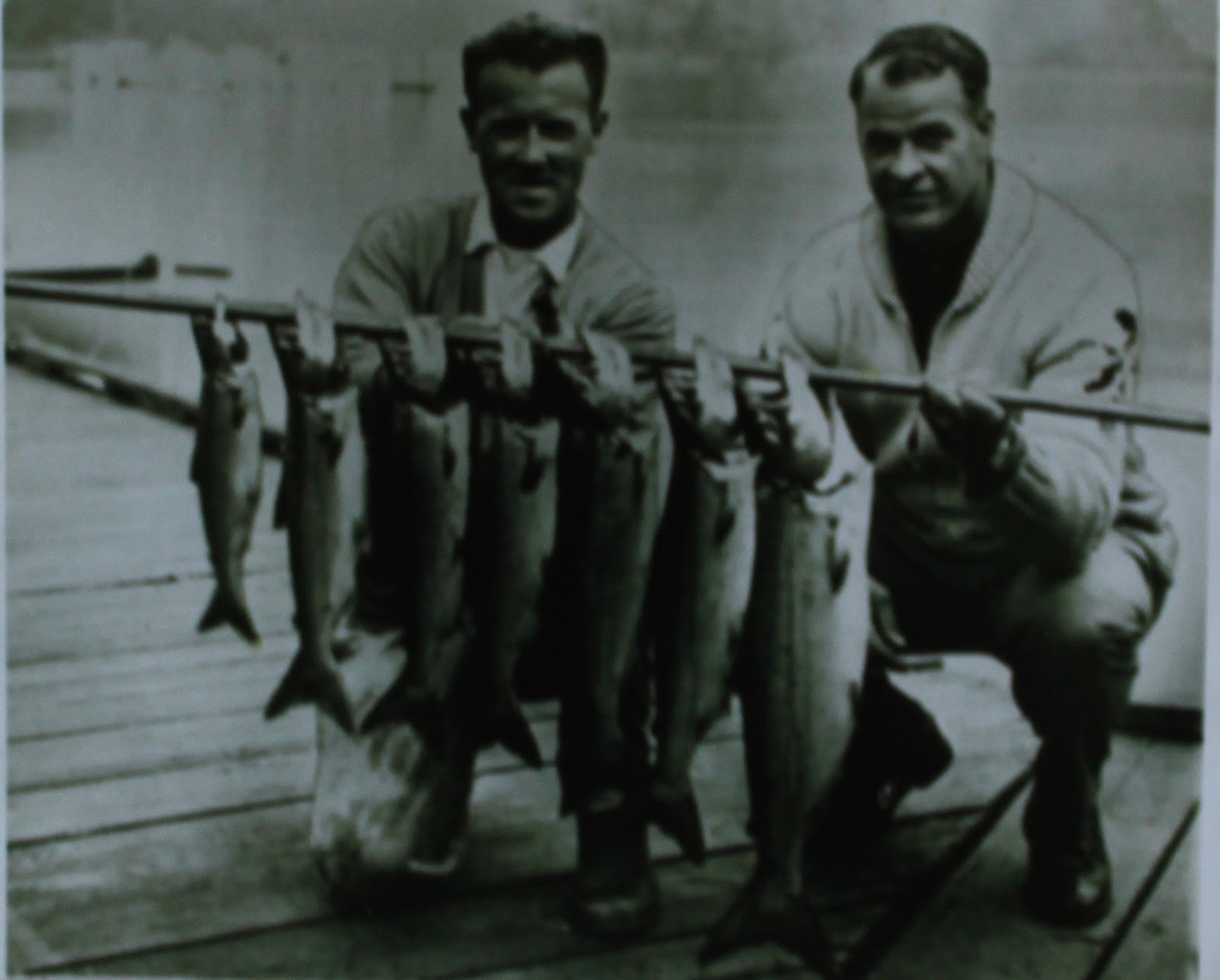
When Tom partnered with local fishing legend Jimmy
Gilbert (who died in 2000), they started designing new salmon tackle and
devised special ways of cutting their baits. They would even ask clients to
swipe their wives’ nylon stockings. These were filled with rocks, then rigged
with a drop release fashioned from a paper clip. When a fish was hooked, the
drop release opened, the rocks fell away, and the fish could then be played
without any weight. If that sounds like a forerunner to the downrigger, you’re
right.
They also developed a system for rigging a whole herring
so it rolled like wounded baitfish. This consisted of a double hook setup
attached to a herring with a wire wrapped around its nose, and the line running
through a metal helmet that fit over its head. Suspending their invention from
a length of line tied to a 12-foot bamboo pole, Tom and Jimmy walked up and
down the dock discussing their new technique as the herring rolled slowly
though the water in an enticing manner. It looked so good, in fact, that a
lingcod living under the dock decided the obviously crippled herring would make
an easy meal. However, the 25-pounder was pulled out onto the dock so fast, it
didn’t have time to react. It was invited to dinner than evening, as the main
course.
Tom did whatever necessary to pay the bills: guiding
on and off for the Gilberts from 1952, cutting herring strip for Rhys Davis,
and working in steel construction. In 1954 his life took a dramatic turn. While
working on a building in Victoria, he fell three stories down an elevator
shaft, landing on a 2- X 12-inch plank laying flat across some vertical rebar
at the bottom. Had the plank not been there it would have meant certain death.
As it was, his back was broken.
Tom lived n a full body cast for over two years. His
doctors said he would never walk again or do any physical work for the rest of
his life. The Workman’s Compensation Board tried having him trained as a
cobbler, but Tom pressed on, living with the pain and continued with his life.
His dream of becoming a fireman like his father was over, and he decided that
doctors weren’t his favourite people.
Despite the pain, Tom still went fishing. He would
stubbornly struggle into a small rowboat, then row out to his boat anchored
offshore. After untying the line from the anchor buoy, he would pull himself up
the stern to climb aboard. While doing this, he once fell in and sank like a
rock. By sheer luck he landed on the anchor chain, which he used as a lifeline
to pull himself 40 feet to the surface. He called out for assistance and was eventually
helped from the water.
Although in constant pain, Tom guided year-round and
continued developing his ideas. The top chinook lures in those days were wooden
plugs. Although productive, he always modified every one by re-carving their
noses, adjusting the tow bars, and trying different colour patterns. A plug
never went into the water unless it looked right and swam properly with an
enticing wiggle. Over time, the plugs absorbed water. The added weight reduced
their action and swelling caused the paint to crack and flake off, making them
virtually useless. As a result, Tom spent much time drying plugs in the oven at
home, then repainting them.
Early on, Tom decided that a plug made from plastic
would never fill with water and would always swim properly. Thus, in 1962,
while living in Brentwood, he perfected the prototype of a 3-inch plug that was
used to make the original die for the first Tomic Plug. They were injection-moulded
from butyrate plastic, with metal tow bars that were inserted by hand. Each was
then spray painted with durable, long lasting lacquer. Little did Tom realize
that this was the birth of Tomic Lures. Ltd.
The original design was a great success. Local guides
and commercial salmon trollers were soon begging for more plugs. As catch rates
increased, Tom was pressured into developing more sizes and colours to match
various types of baitfish and water conditions. The Tomic line increased to 5-
and 7- inch models, then 4- and 5-inches.
Tom created a flasher that became popular with the
commercial industry, a large, washboard design introduced as the Sonic. It was
very effective, but too big for sport fishing. He still sells a few, though,
mainly as attractors for downrigger fishing.
When some markets requested a jointed plug, Tom set
about creating one. The 4-inch Classic Plug was redesigned into a jointed model
rigged with two treble hooks. The Broken Back swims like a live baitfish and is
now a standby for anglers throughout the world.
When the commercial salmon industry was booming, Tomic
Lures Ltd. was a major player with 7,000 trollers from California to Alaska. Running
two shifts with up to 25 employees, Tom’s small plant in Sooke was hard pressed
to keep up with the demand. When the commercial troll fishery started its
demise in 1984, Tom realized his business would decline accordingly, meaning it
was time to rethink the market.
These days his main markets are still in North
America, but orders from Europe’s Atlantic salmon, pike and trout anglers have
been growing steadily. Since, 1996, Tomic Plugs have been No. 1 in Sweden, and
the lure of choice for every Lax Cup Derby, the world’s largest Atlantic salmon
derby. Americans who favour striped bass, bluefish, tarpon and wahoo, use so
many plugs that Tom’s winter slow periods are now booming. And of course, they
are popular on the Great Lakes for chinooks and coho, and elsewhere for lake
trout.
Now in his late 60s, Tom continues playing with new
ideas, and recently introduced a spoon to sport anglers that he had sold for
years to commercial fishermen in Washington, Oregon and California. Quickly
becoming a favourite with many anglers in British Columbia, Road Runners are
available in three sizes from 3 to six inches – in colours that have been
catching big salmon and trout for years.
Tom recently sold the Sooke property and shop that was
so much a part of his life in 1969, then purchased some beautiful property near
Campbell River. There he established a new factory and continues creating lures
for hard core anglers. Having seen the best and the worst of salmon fishing on
the West Coast, he is still dedicated to helping people catch fish. He also does
his best to get out fishing more, and still catches his share – and still
changes his gear every 20 minutes, whether the bite is on or off.
Although he might stretch the truth a bit while relating
the occasional fish story, he is as honest as they come. He believes what he
says, so you can, too. He doesn’t fish Saanich Inlet anymore, referring to it
as the Dead Sea, and hates visiting Victoria because he despises the changes
caused by urbanization. He swears at seals when they take his fish, hates computers,
and loves fishing and deer hunting. He’s a true dinosaur – the best of his kind.
I consider myself lucky to have been taught to fish by one of the best in the
business – my father Tom Moss.
(This originally ran in Island Fisherman
in the early 2000s. It is among the extensive Jimmy Gilbert memorabilia
maintained by Joan Gilbert, who kindly let me snap hundreds of images earlier
in 2018. These will appear on this blog in due course.
Of the many Tomic plugs I own, some were particularly good in Saanich Inlet
when I learned to saltwater fish in the '70s and '80s: the 225, a pink plug,
and the 427, a greenish one.)


 ,
, 